Every project begins with an idea—but bringing that idea into the physical world often requires curiosity, experimentation, and a willingness to try something new.
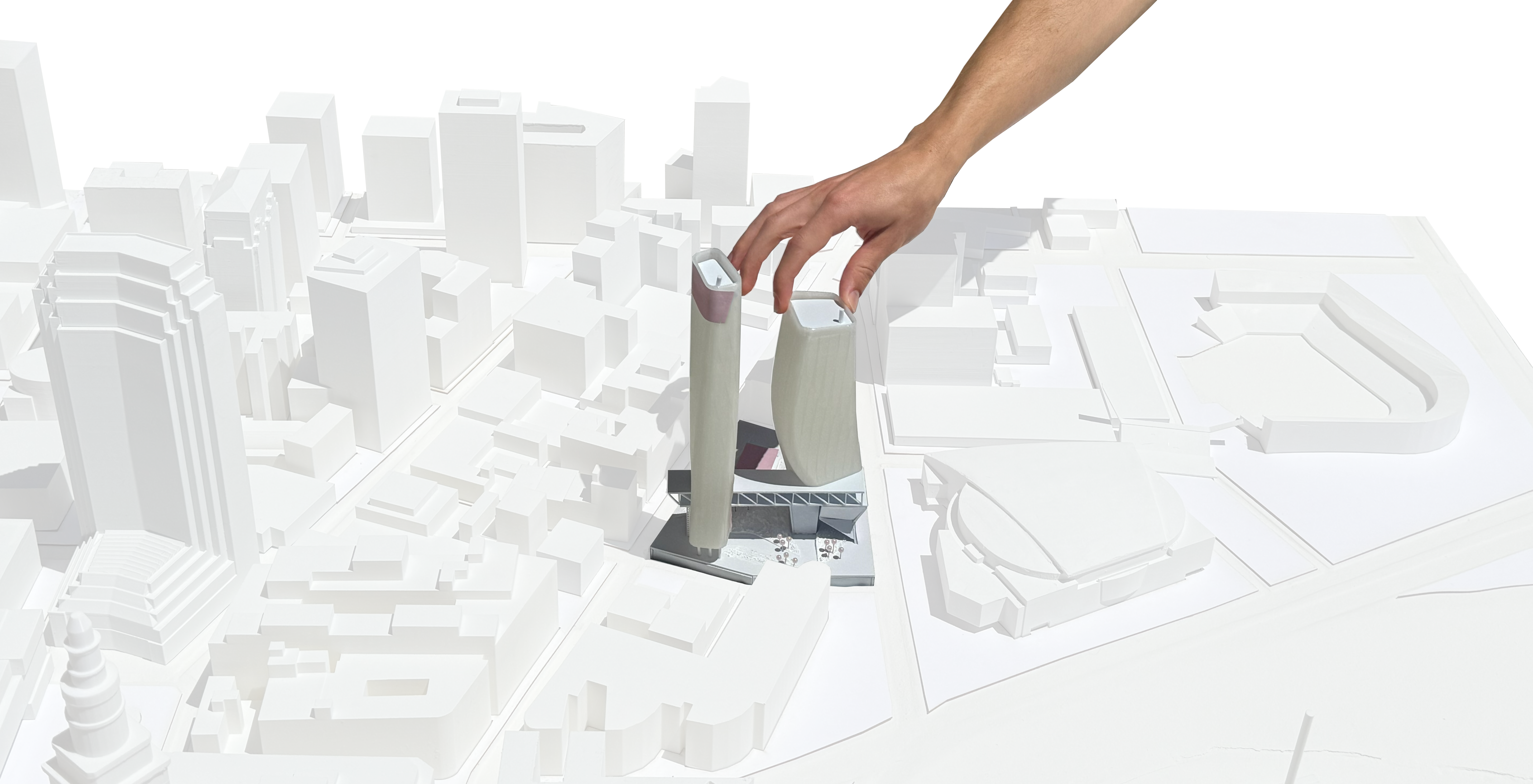
For Andrew Kidd, a recent graduate of 5X社区's Master of Architecture program, that process meant combining architectural theory, digital fabrication, new materials, and a little trial and error to create SUPERV(er)ISION, an ambitious architectural model that challenges conventional ideas about how buildings are organized.
Along the way, the Design Innovation Hub became an important partner in helping him transform a complex digital design into a tangible prototype.
The DI Hub gives students the opportunity to learn a variety of digital fabrication techniques and software while providing a space where they can experiment, fail, and improve.
From Northern Kentucky to Kent State
Originally from Northern Kentucky, just south of Cincinnati, Kidd completed both his undergraduate and graduate degrees in Architecture at 5X社区.
Like many architecture students, he often found himself working late into the night refining designs and searching for the best way to build presentation models. It was during one of those late nights that he first discovered the Design Innovation Hub.
"Like most things, I was working late one night, strategizing about how to build a model," Kidd said. "My friend told me about the DI Hub... so I jumped at the opportunity to become a member and access the space."
That decision would ultimately play an important role not only in this project, but in his graduate thesis work as well.
Rethinking the Modern High-Rise
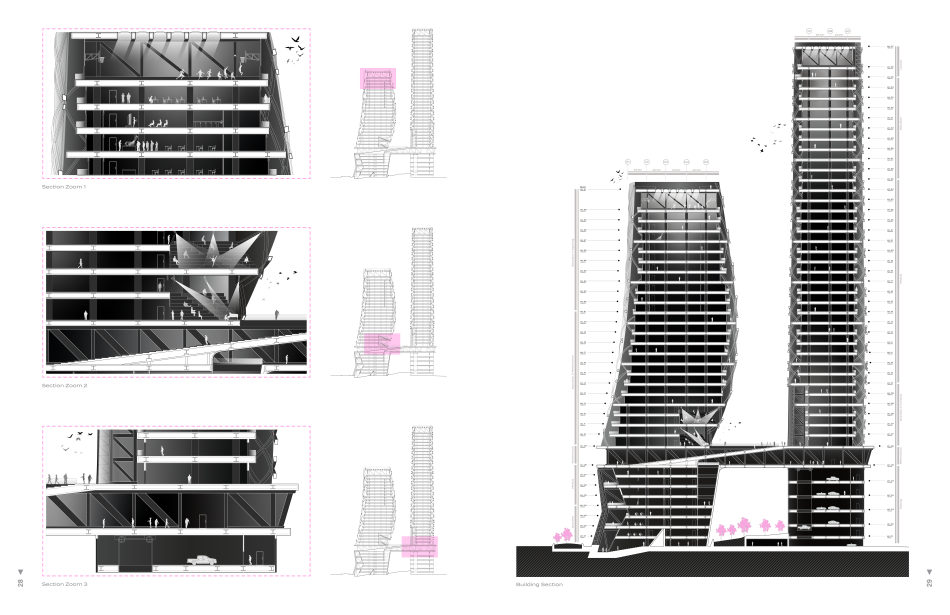
Kidd's project, SUPERV(er)ISION, is a proposed mixed-use high-rise designed for a site adjacent to Rocket Mortgage FieldHouse in downtown Cleveland. The title itself is a play on the words supervision and super-subversion—a clue that the project intentionally challenges expectations.
Rather than simply designing another high-rise, Kidd explored what would happen if many of the assumptions people make about office buildings were turned upside down. The inspiration came from an unusual source.
At the beginning of the semester, students in Professor Ron Tannenbaum's architecture studio were asked to select an object from the Cleveland Museum of Art and translate it into a single verb that would guide the design process.
Kidd selected the .
"The reason I chose this object had less to do with the sculpture itself and more to do with the image created by the glass sphere, which subverted the reality of what appeared behind the jewel," Kidd explained.
That concept of subversion became the driving force behind the entire project.
Rather than expressing the idea only through the building's form, Kidd applied it to the way the building actually functions. Spaces were intentionally reorganized to challenge traditional expectations—for example, placing the CEO suite in the basement while moving the lobby to the top floor. Through a series of mirrored, reflected, and reversed relationships, the building encourages occupants to rethink hierarchy, movement, and experience within the built environment.
Bringing Complex Ideas Into Physical Form
While the architectural concept was ambitious, building a physical model presented an entirely different challenge.
One of the most rewarding aspects of the project, according to Kidd, was experimenting with unfamiliar materials and fabrication techniques.
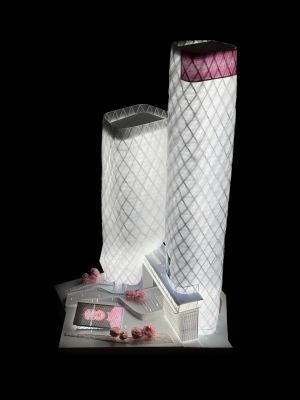
"The most rewarding part of this project was learning and experimenting with new materials for the model, such as DuraLar and a very thin acrylic paper that can be used to simulate frosted glass panes," he said. "I also enjoyed incorporating electronics into the model to make it glow."
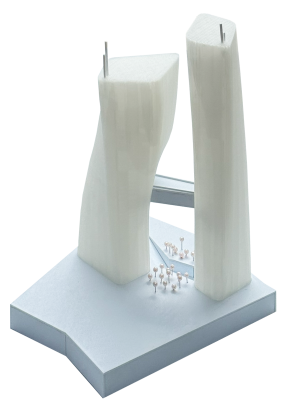
Creating the intricate lattice structure proved especially challenging. Because of its complex doubly curved geometry, the model required extensive testing before a successful print could be achieved.
Working alongside Design Innovation staff, Kidd experimented with multiple support strategies until they found an approach that accurately reproduced the digital design. Beyond 3D printing, he also received guidance on integrating the electronic components that illuminate the finished model.
Everyone at the DI Hub has been incredibly generous with both their time and their knowledge.
Learning Through Experimentation
For Kidd, one of the greatest benefits of using the Design Innovation Hub was not simply access to equipment—it was the opportunity to develop new skills through hands-on experimentation.
One unexpected breakthrough came while searching for a better way to wrap the building's fa?ade.
"The biggest challenge in making this project was wrapping the fa?ade in acrylic," Kidd said. "That's why I was very happy to later discover DuraLar."
Experiences like these reinforced the value of learning through iteration.
"The DI Hub gives students the opportunity to learn a variety of digital fabrication techniques and software while providing a space where they can experiment, fail, and improve," Kidd said. "It allows students to become much more skilled at fabricating their own work instead of simply handing it off to someone else."
Looking Ahead
Although the studio project has concluded, its impact continues.
Kidd and his classmates are currently exploring opportunities to exhibit selected projects from the studio at the Cleveland Museum of Art, allowing a broader audience to experience the innovative ideas developed throughout the semester.
Since completing SUPERV(er)ISION, Kidd has graduated with his Master of Architecture degree, continued using the Design Innovation Hub's 3D printers to support his graduate thesis, and recently began his professional career at the architecture firm , where he is contributing to a building renovation project.
Looking back on his experience, Kidd enthusiastically recommends the Design Innovation Hub to future students.
I would highly recommend the DI Hub to everyone, but especially to architecture students, because it allows you to develop a deep understanding of 3D printing and digital fabrication through hands-on experience...
Start Your Next Project at Design Innovation
Whether you're designing an architectural model, developing a research prototype, creating artwork, exploring entrepreneurship, or simply learning a new skill, the Design Innovation Hub provides the people, spaces, and technology to help bring ideas to life.
Open to all Kent State students, faculty, staff, alumni, and community members, the Design Innovation Hub offers access to makerspaces, emerging technologies, equipment training, project consultations, and expert staff who are ready to help at every stage of the creative process.
Every project starts somewhere. Start yours here.